SIZE NOTE · Miniature Creatures · TOP 6
Miracles Fitting on a Fingertip: The World's Smallest Mammals, Bird, and Reptile
Learn about the Etruscan shrew, Kitti's hog-nosed bat, the bee hummingbird, and Nano-chameleon.

Quick Answer
While nature holds giant creatures as large as houses like the blue whale, there are also creatures so tiny and adorable that they defy imagination.
How did these tiny living beings—lighter than a single coin and no larger than a sunflower seed—survive in the harsh wild?
Today, we introduce four extraordinary creatures recognized as the smallest mammals, bird, and reptile on Earth.
1. World's Lightest Mammal: Etruscan Shrew
 Etruscan shrew
The animal holding the title of the lightest mammal is the Etruscan shrew.
Etruscan shrew
The animal holding the title of the lightest mammal is the Etruscan shrew.
Its body length excluding the tail is only about 3.5–5 cm, with an average body weight of just 1.8 g. It is significantly lighter than a 100-won coin (approx. 5.4 g).
 Cowering Etruscan shrew
To maintain such a tiny body size, their metabolism runs at an astonishing pace.
Cowering Etruscan shrew
To maintain such a tiny body size, their metabolism runs at an astonishing pace.
Its heart rate reaches up to 1,500 beats per minute, and to continuously replenish energy, it must hunt and consume 1.5 to 2 times its own body weight in insects every day. It is, in effect, a tiny but voracious predator.
2. World's Smallest Mammal: Kitti's Hog-nosed Bat
 Kitti's hog-nosed bat
By length, the smallest mammal is Kitti's hog-nosed bat. Because it is as tiny as a bee, it is also known as the 'Bumblebee Bat'.
Kitti's hog-nosed bat
By length, the smallest mammal is Kitti's hog-nosed bat. Because it is as tiny as a bee, it is also known as the 'Bumblebee Bat'.
Its head-and-body length is approximately 2.9 to 3.3 cm—roughly the length of an adult's thumb joint—with a body weight between 1.5 and 2 g.
 Kitti's hog-nosed bat resting on a finger
True to its name, a defining feature is its pig-like snout. They live in colonies deep inside limestone caves in western Thailand and southeastern Myanmar, flying out briefly at dusk or dawn to hunt insects mid-air. Human disturbance in caves, limestone extraction, and deforestation of its feeding habitat continue to threaten this tiny bat.
Kitti's hog-nosed bat resting on a finger
True to its name, a defining feature is its pig-like snout. They live in colonies deep inside limestone caves in western Thailand and southeastern Myanmar, flying out briefly at dusk or dawn to hunt insects mid-air. Human disturbance in caves, limestone extraction, and deforestation of its feeding habitat continue to threaten this tiny bat.
3. World's Smallest Bird: Bee Hummingbird
 Bee hummingbird
The world's smallest bird is the bee hummingbird (Mellisuga helenae), found exclusively in Cuba among all hummingbird species.
The male's body length is about 5 to 6 cm including the tail, weighing around 1.6 to 2 g. This is lighter than an ostrich's eyeball.
Bee hummingbird
The world's smallest bird is the bee hummingbird (Mellisuga helenae), found exclusively in Cuba among all hummingbird species.
The male's body length is about 5 to 6 cm including the tail, weighing around 1.6 to 2 g. This is lighter than an ostrich's eyeball.
 Bee hummingbird feeding on nectar
True to its name, it is similar in size to a honeybee, and even the buzzing sound of its wingbeats resembles an insect. To feed on flower nectar, it can flap its wings nearly 80 times per second to hover in place.
Bee hummingbird feeding on nectar
True to its name, it is similar in size to a honeybee, and even the buzzing sound of its wingbeats resembles an insect. To feed on flower nectar, it can flap its wings nearly 80 times per second to hover in place.
During breeding season, the male displays its beauty as its head and throat turn a brilliant iridescent red (or pink).
4. World's Smallest Reptile: Nano-chameleon (Brookesia nana)
The miniature reptile that astonished scientists is the nano-chameleon (Brookesia nana). Its known specimens were collected in Madagascar in 2012 and formally described as a new species in 2021.
 Various views of Nano-chameleon
The male's body length excluding the tail is only about 13.5 mm, and just 22 mm including the tail. It is small enough to fit comfortably on a human fingernail, about the size of a sunflower seed.
(Females are slightly larger than males, measuring around 29 mm.)
 Nano-chameleon on a finger
Unlike typical chameleons, it lives not in trees but in the leaf litter layer (ground) of rainforests, hunting extremely small insects like mites and springtails.
Nano-chameleon on a finger
Unlike typical chameleons, it lives not in trees but in the leaf litter layer (ground) of rainforests, hunting extremely small insects like mites and springtails.
Being so small makes maintaining body temperature challenging, which appears to have driven the evolution of its unique survival strategies. However, as its forest habitat suffers destruction, it faces extinction concerns from the very moment of its discovery.
Small Yet Magnificent Creatures
| Taxonomy | Small Species | Representative Metric | Measurement Notes |
|---|---|---|---|
| Mammal | Etruscan shrew | Approx. 1.8–3 g | Mass-based standard |
| Mammal | Kitti's hog-nosed bat | Head-body 29–33 mm, approx. 1.7–2 g | Candidate by length standard |
| Bird | Bee hummingbird | Approx. 1.95 g | Sex / individual variations |
| Reptile | Nano-chameleon (Brookesia nana) | 13.5 mm – 21.6 mm | Very small sample size |
Belonging to distinct taxonomic classes—mammals, birds, and reptiles—these animals demonstrate the evolutionary mystery of 'extreme miniaturization.' Just as magnificent as colossal dinosaurs or whales, these creatures so small they require a magnifying glass are equally wondrous parts of nature.
Check out the ScaleCheck exhibition to observe their scale in greater detail.
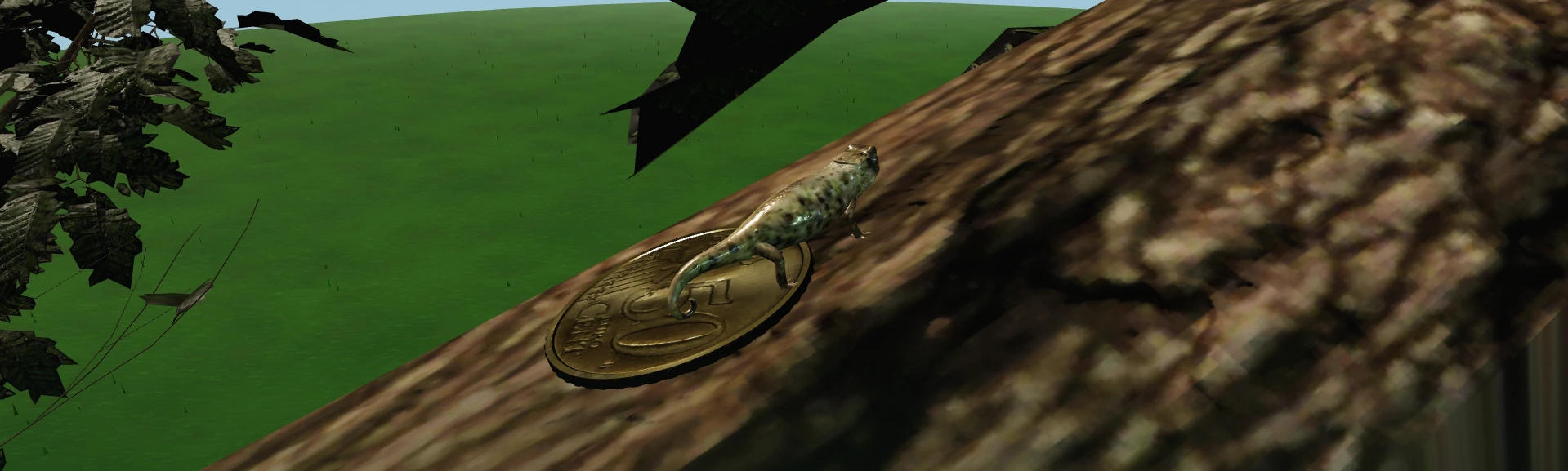
RELATED 3D EXHIBIT · 004
See it at true scale.
Explore Smallest Vertebrates on Earth to place this subject beside others at true scale.
Enter exhibitSOURCES
Sources

What Is the World's Smallest Vertebrate? The Frog That Fits on a Coin
Learn about Paedophryne amauensis, a frog with an average body length of just 7.7 mm.
Read story
Megalodon vs. Blue Whale: Which Was Actually Larger?
Compares fossil estimates of Megalodon's length with actual blue whale records, explaining why figures vary across studies.
Read story