SIZE NOTE · Miniature Creatures · TOP 6
What Is the World's Smallest Vertebrate? The Frog That Fits on a Coin
Learn about Paedophryne amauensis, a frog with an average body length of just 7.7 mm.

Quick Answer
When discussing the world's smallest animals, there is one living creature that can never be omitted.
Outranking fish, birds, and mammals alike, the tiny frog Paedophryne amauensis earned a place in the Guinness World Records as the 'smallest vertebrate on Earth.'
Just how small is it to hold the title of the world's smallest vertebrate?
Overwhelmingly Small: Less Than 1 cm
 Paedophryne amauensis on a leaf
The average body length of Paedophryne amauensis is a mere 7.7 mm.
Paedophryne amauensis on a leaf
The average body length of Paedophryne amauensis is a mere 7.7 mm.
Measuring under 1 cm, it is so tiny that space remains even when placed on a Korean 10-won coin or a human pinky fingernail.
Before this frog was officially reported to the scientific community in 2012, the smallest vertebrate was an 8 mm cyprinid fish discovered in Indonesia (Paedocypris progenetica), but the discovery of this tiny frog claimed the number one spot.
Why Was It Discovered So Late?
This frog was first discovered in 2009 by an American research team in a forest near the village of 'Amau' in Papua New Guinea (the species name 'amauensis' derives from this village).
 Paedophryne amauensis with wood-like skin coloration
There were good reasons for the late discovery:
- Perfect Camouflage
In addition to its minute size, its skin pattern of mottled dark brown and black blends seamlessly into the damp leaf litter on the forest floor. - Insect-like Call
During mating season, the male's call is not a typical frog croak, but a high-pitched insect-like "peep-peep" sound.
Consequently, it was long mistaken for the sound of crickets or insects in the forest. Researchers were able to locate them only after an arduous process of scooping up handfuls of leaf litter into plastic bags to trace the origin of the sound.
A Frog Without a Tadpole Stage?
 Paedophryne amauensis
Another remarkable feature of this small frog is that it has 'no tadpole stage.'
Paedophryne amauensis
Another remarkable feature of this small frog is that it has 'no tadpole stage.'
While typical frogs hatch from eggs as tadpoles, grow in water, and sprout legs, Paedophryne amauensis lays eggs on the damp forest floor, hatching directly into fully formed miniature frogs without tails.
Being so tiny, it evolved to bypass open water to avoid numerous aquatic predators as well as the risk of water puddles drying up.
Survival Strategy of a Tiny Body
Inhabiting beneath the thick, damp leaf litter layer of rainforests, they survive by hunting even smaller, microscopic invertebrates such as mites and springtails. Although their small size leaves them vulnerable to rapid moisture evaporation, they overcame this challenge by choosing the constantly humid under-litter environment as their habitat.
 Paedophryne amauensis smaller than a leaf
Evolution continuing out of sight
The discovery of Paedophryne amauensis is an important benchmark showing the biological limits of how small a vertebrate can become. Beneath the damp leaf litter we carelessly step on lies a universe of wondrous living beings that have honed their own survival methods over millions of years.
Size Comparison
| Subject | Representative Size | Compared to the 7.7 mm Frog |
|---|---|---|
| Paedophryne amauensis | Average 7.7 mm | Baseline |
| Adult Pinky Fingernail Width | Approx. 10–13 mm | The frog is shorter |
| Small Coin | Diameter approx. 18 mm | Less than half the diameter |
Experience the Wondrous Scale Yourself
 Paedophryne amauensis viewable in ScaleCheck
Understanding how small this frog is in reality can be difficult through the number 'average 7.7 mm' alone.
Paedophryne amauensis viewable in ScaleCheck
Understanding how small this frog is in reality can be difficult through the number 'average 7.7 mm' alone.
If you are curious about the actual size of this tiny creature you have only imagined, we recommend observing it directly through the ScaleCheck exhibition.
By rotating and zooming in on Paedophryne amauensis placed side by side with a 10-won coin or a human fingertip, experience the vivid wonder of the 'smallest vertebrate' crafted by evolution.
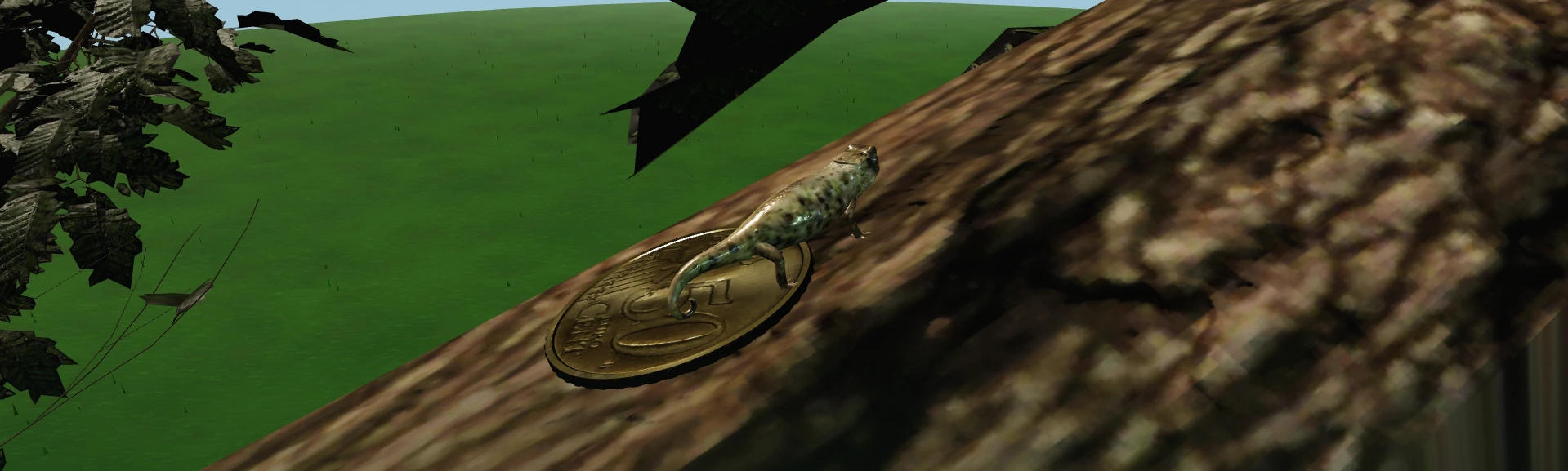
RELATED 3D EXHIBIT · 004
See it at true scale.
Explore Smallest Vertebrates on Earth to place this subject beside others at true scale.
Enter exhibitSOURCES
Sources

Miracles Fitting on a Fingertip: The World's Smallest Mammals, Bird, and Reptile
Learn about the Etruscan shrew, Kitti's hog-nosed bat, the bee hummingbird, and Nano-chameleon.
Read story
The Largest Creature on Earth: The Blue Whale
Introducing the overwhelming size and characteristics of the blue whale, the largest creature on Earth, for an intuitive understanding at a glance.
Read story