SIZE NOTE · Giant Marine Animals · TOP 9
Megalodon vs. Blue Whale: Which Was Actually Larger?
Compares fossil estimates of Megalodon's length with actual blue whale records, explaining why figures vary across studies.

Quick Answer
Based solely on confirmed length records, the blue whale is longer.
Large individual blue whales measure around 29 m, with historical record individuals reaching approximately 33 m.
Lacking complete fossil skeletons, Megalodon was long estimated at around 15–18 m, though a 2025 study suggested a potential maximum of up to 24.3 m.
Size Comparison
| Subject | Estimated Size | Basis / Evidence |
|---|---|---|
| Large Blue Whale | Approx. 29 m | Observations and records of modern individuals |
| Historical Maximum Blue Whale | Approx. 33 m | Historical whaling records |
| Conservative Megalodon Estimate | Approx. 15–18 m | Proportional estimation from tooth and vertebra fossils |
| Recent Megalodon Upper-bound Hypothesis | Up to approx. 24.3 m | 2025 body-reconstruction study |
(To avoid exaggerating uncertainties between studies, the ScaleCheck exhibition presents Megalodon at 18 m and the blue whale at 33 m, close to its historical maximum record.)
Why Do Megalodon Size Estimates Keep Changing?
 Fossil tooth of a Megalodon
Most of a shark's skeleton consists of cartilage, which rarely preserves as fossils.
Fossil tooth of a Megalodon
Most of a shark's skeleton consists of cartilage, which rarely preserves as fossils.
For Megalodon, mostly large teeth and some vertebrae have been discovered.
Researchers estimate total body length by comparing these fossil fragments with the body proportions of various living sharks.
Results vary depending on which extant shark species is used as a reference and how head, trunk, and tail proportions are reconstructed.
Differences in Length, Weight, and Body Shape
 View of a blue whale
While the blue whale holds a clear advantage in length, the body shapes and lifestyles of these two animals are completely different.
View of a blue whale
While the blue whale holds a clear advantage in length, the body shapes and lifestyles of these two animals are completely different.
The blue whale, which feeds primarily on krill, evolved a long, smooth, streamlined body to swim flexibly and rapidly through open oceans. Large individuals easily exceed 150 tons in weight.
In contrast, Megalodon was an ancient apex predator that hunted small-to-medium-sized cetaceans. To bite and subdue prey, it is estimated to have possessed massive jaws and an extremely thick, heavy, muscular build.
Based on an 18 m individual, its weight is estimated to have reached approximately 50 to 70 tons.
The Cross-Era Meeting of Two Giants
 Size comparison between Megalodon and a human
The blue whale and Megalodon lived in different geological eras and never actually crossed paths in the ocean.
Size comparison between Megalodon and a human
The blue whale and Megalodon lived in different geological eras and never actually crossed paths in the ocean.
Whales were able to evolve to their immense current sizes only after Megalodon went extinct.
Though they could never meet in reality, ScaleCheck's 3D exhibition allows you to view these two rulers of the ocean side by side in the same space.
Experience a direct comparison between the grand majesty of the longest animal in Earth's history, the blue whale, and the overwhelming size of history's most powerful predator, Megalodon.
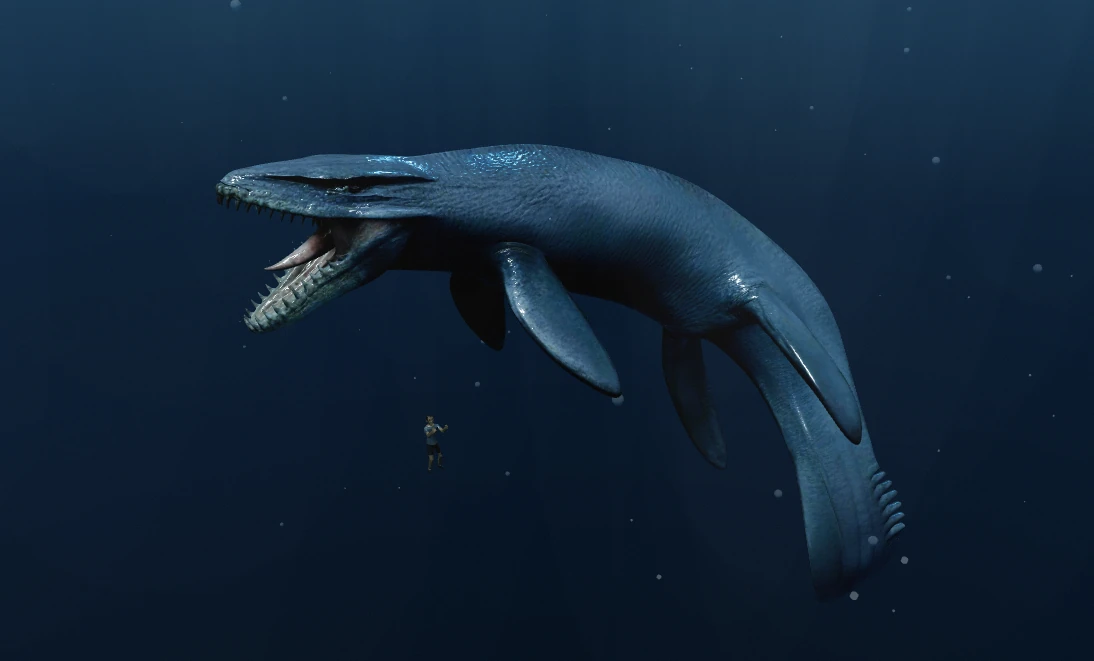
RELATED 3D EXHIBIT · 001
See it at true scale.
Explore Largest Marine Animals in History to place this subject beside others at true scale.
Enter exhibitSOURCES
Sources

The Largest Creature on Earth: The Blue Whale
Introducing the overwhelming size and characteristics of the blue whale, the largest creature on Earth, for an intuitive understanding at a glance.
Read story
What Is the World's Smallest Vertebrate? The Frog That Fits on a Coin
Learn about Paedophryne amauensis, a frog with an average body length of just 7.7 mm.
Read story